NEWS REFERENCE
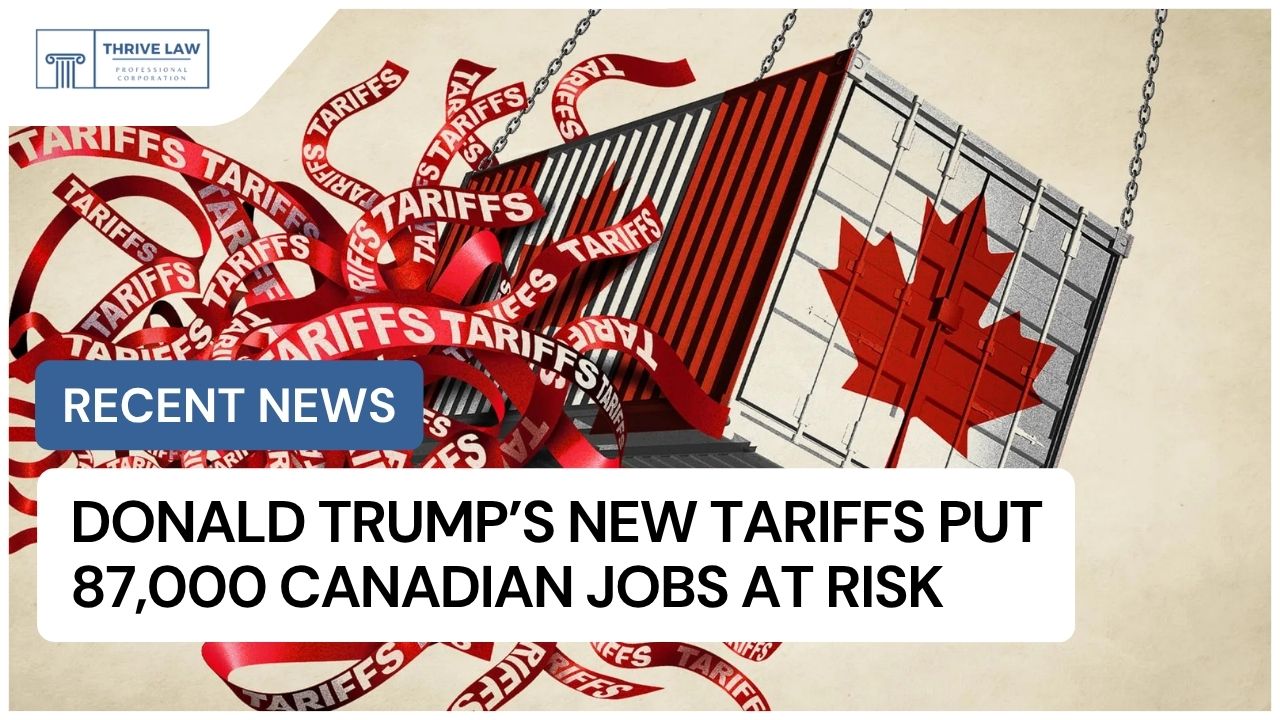
Statistics Canada released its August 2026 Labour Force Survey showing the Canadian economy lost 42,000 jobs last month. Despite the losses, the unemployment rate held steady at 6.4%. Manufacturing added 22,000 jobs — but business, public administration, and natural resources sectors saw significant declines. Economists have attributed the uncertainty to rising trade tensions between Canada and the United States and incoming retaliatory tariffs, which may further dampen business confidence and hiring in the months ahead.
Watch the full CTV News report below
What These Numbers Mean for Ontario Workers
A national jobs report is a data point. But behind every number is a real person — someone who got a call, received a letter, or was pulled into a meeting they did not expect.
If you lost your job in August — or if you are worried about losing it in the weeks ahead as tariff pressures mount — here is what Ontario law says you are entitled to.
Your Rights Do Not Change With the Economy
When businesses cut jobs because of trade uncertainty, tariff pressure, or declining revenue, those are legitimate business reasons. But they do not reduce what employees are legally owed.
A termination driven by economic conditions is still a termination without cause. And termination without cause triggers the full range of Ontario ESA and common law entitlements — regardless of why the decision was made.
What You Are Entitled To
ESA termination pay — one week of notice or pay in lieu per year of service, up to eight weeks.
ESA severance pay — if you have five or more years of service and your employer’s payroll exceeds $2.5 million, you are entitled to one additional week per year of service — up to 26 weeks — on top of termination notice.
Common law reasonable notice — Ontario courts regularly award significantly more than ESA minimums based on your age, seniority, length of service, and how difficult it will be to find comparable work in a contracting labour market. In a period of rising unemployment and trade uncertainty, that difficulty is real — and it strengthens your claim.
Everything else in your package — pro-rated bonus, benefits continuation, unused vacation pay, and unvested equity must all be included. They frequently are not.
The Tariff Factor — Why This Moment Is Different
Economists quoted in the CTV report specifically flagged incoming retaliatory tariffs as a risk to future hiring and business confidence. That matters legally.
When finding comparable work becomes harder — because an entire sector is contracting, because trade disruption is reducing hiring across industries, because the labour market is tightening — Ontario courts factor that difficulty into reasonable notice awards. A job market under tariff pressure is not the same as a stable one. Your severance should reflect that.
What to Do Right Now
1/ Do not sign any release without legal advice — your employer’s first offer is rarely your full entitlement.
2/ Apply for EI immediately — do not wait for severance negotiations to conclude. Apply at Service Canada as soon as your employment ends.
3/ Check whether mass termination rules apply — if your employer is cutting 50 or more employees at once, enhanced notice requirements apply on top of your individual entitlement.
4/ Calculate your full picture — base salary, bonus, benefits, and equity all count toward your total severance entitlement.
5/ Get legal advice — especially if you are a long-service or senior employee. The gap between what is offered and what you are owed is often significant.
The bottom line: 42,000 jobs lost in one month is a statistic. If you were one of them, it is your livelihood. Ontario law protects you regardless of what caused the job loss — and in a labour market facing trade headwinds, knowing what you are owed matters more than ever.